
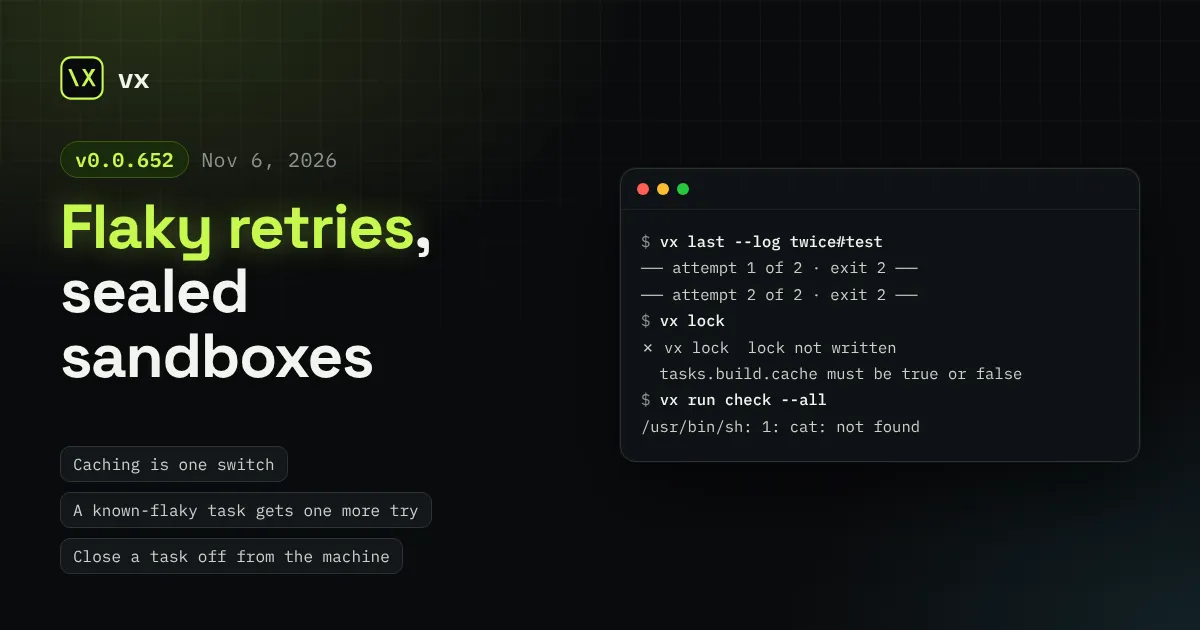
Flaky retries, sealed sandboxes
A known-flaky task gets one more try, on any machine. A sandboxed task can be sealed off from the machine and reads the outputs it depends on. cache: true is a switch, and outputs stand on their own.
Distributed task execution sends a task to the machine type it names. Workers and servers run only while needed. Every task is one line; config refusals point at their line.
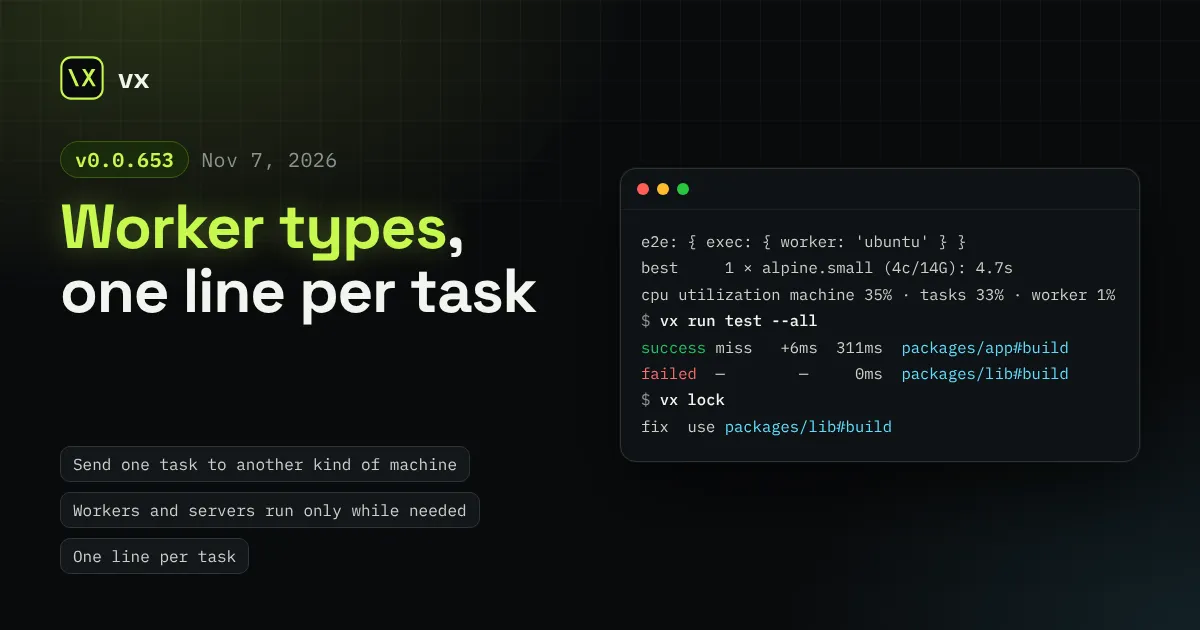
Distributed task execution can send one task to another kind of machine. Workers and servers run only while a task needs them. The task list is one line per task.
A failed cache restore fails its task. A config mistake is shown at its line.
This release is breaking. Read the breaking changes first.
In this release
With Alpine workers, there was no way to send one Playwright task to
Ubuntu. exec.platforms says where a task can run, and every
Linux worker looked the same.
dte() now names worker types, each with its machines. A task
picks a type with exec.worker.
Any other task goes to the first type, in declared order, with a machine on one of its platforms. A costly type listed last gets only the tasks no other type can take.
dte({ workers: { alpine: { machines: { small: { max: 8, cpu: 4, memory: '16GB' } } }, ubuntu: { machines: { small: { max: 2, cpu: 4, memory: '16GB', runsOn: 'ubuntu-latest' } } }, }, adapter: github(),})import { defineProject } from '@vzn/vx/config'
export default defineProject({ tasks: { e2e: { exec: { command: 'bunx playwright test', worker: 'ubuntu' } }, },})A name no type has, or a type with no machine on the task’s platforms,
refuses the run before any worker starts. On your own machine
exec.worker is ignored, and it never changes a cache key.
See Distributed task execution.
A run could start four Macs for work two would finish long before the Linux work ended, and a short arm task waited behind x64 work while the arm worker sat idle.
Now every ready task goes to the run’s own queue, which knows which platform’s worker is free. A platform starts the fewest workers that still finish its work two warm-ups before the run ends.
A machine counts as crowded only when its cores are all busy, so a
task is booked by the CPU it used. The footer’s best line uses the
same rule, so it advises the workers the run would start.
The footer also says where each worker’s CPU went, from its first task to its last: the machine’s, its tasks’ and the worker process’s own.
$ VX_DTE_RUN=$(uuidgen) vx run test --all workers alpine.small#1 stopped 4 done · warm-up 0.1s declared 4c/14G · actual 4c/14G online 4.6s · busy 4.6s · idle 0.0s cpu peak 2.0 · used avg 1.3 cores · machine avg 1.4 · booked avg 1.3 cpu utilization machine 35% · tasks 33% · worker 1% memory peak 11.5 MB · avg 7.6 MB sent 3 messages · 5 KB, received 4 messages · 1 KB probe at 0.0s: 4 tasks left to run, 4 known misses asked 1 at 0.0s for 4 tasks (4 measured), plan 24.5s ideal 4.7s: each task as long as it took, placed perfectly best 1 × alpine.small (4c/14G linux-x64): 4.7s, the fewest of its sizes any 1 × (2c/7G linux-x64): 4.7s, of any cores, the least core time total cpu utilization machine 35% · tasks 33% · worker 1%A dev server a test depends on ran until the whole run ended, holding its machine’s cores while unrelated tasks ran.
Now a server gets SIGTERM as soon as every task that uses it has
finished, while the rest of the run goes on. On a worker it stops the
same way, and starts again if a later task there needs it.
flowchart LR
  serve[serve ready] --> e2e[e2e runs]
  e2e --> stop[serve stopped]
  lint[lint keeps running] ~~~ stop
A worker also learns what a server costs: its idle CPU, booked once per worker, and the CPU each dependent adds while it runs. Workers are no longer overfilled by servers no task was charged for.
See Distributed task execution and Dev servers as graph nodes.
The task list had two rules, a repeated header, a glyph column and blank cells, so a row took a moment to read.
Now each section is one underlined line that carries the column header. A row starts with its status, then cache, the change from its usual time, and time.
An empty cell reads —, and a yellow ◆ before a name marks the
critical path. vx last draws the same grid. Under --all, a cache hit
prints no row.
$ vx run test --all  Tasks     status  cache     ±usual    time   cpu    mem outputs  blocks worker         task                                       success miss        +6ms   311ms    2%  3.6MB     34B       1 local          packages/app#build            success miss        +3ms   208ms    2%      —      0B       0 local          packages/app#test

  Summary                                                                                                       vx 0.0.653  projects  ▰▰▰▰▰▰▰▰▰▰▰▰▰▰▰▰▰▰▰▰▰▰▰▰▰▰▰▰▰▰▰▰▰▱▱▱▱▱▱▱▱▱▱▱▱▱▱▱▱▱            2 affected · 3 total  tasks     ▰▰▰▰▰▰▰▰▰▰▰▰▰▰▰▰▰▰▰▰▰▰▰▰▰▰▰▰▰▰▰▰▰▰▰▰▰▰▰▰▰▰▰▰▰▰▰▰▰▰            4 success · 4 total  cache     ▰▰▰▰▰▰▰▰▰▰▰▰▰▰▰▰▰▰▰▰▰▰▰▰▰▰▰▰▰▰▰▰▰▰▰▰▰▰▰▰▰▰▰▰▰▰▰▰▰▰            local 2✓ 2↑
  info      4 workers · local cache · run 01a1b5f9-2a6d-75d7-b693-e812b8a4d408  time      573ms · max 311ms · avg 260ms · min 208ms
See Running tasks.
A cache hit whose restore failed read as a miss that ran: a $ command
line for a command that never ran, exit 1, and a miss in history.
Now such a task is failed and nothing else: no miss, no hit, no command.
Its row reads failed; its frame and vx last say
cache restore failed, and the cache bar shows it in red.
$ vx run build --filter packages/lib  Tasks     status  cache     ±usual    time   cpu    mem outputs  blocks worker         task                                       failed  —              —     0ms     —      —       —       0 local          packages/lib#build
┌─ packages/lib#build > failed (cache restore failed)├─ OUTPUT ────────────────────────────────────────────────────
[vx] packages/lib#build: /home/user/acme/packages/lib/dist is a symbolic link to /home/user/out, outside /home/user/acme/packages/lib — vx never cleans, saves or restores declared outputs through a link that leaves the project. Remove the link and re-run, or stop declaring outputs under it.
└─ packages/lib#build ── (0ms) failed (cache restore failed)

  Summary                                                                                                       vx 0.0.653  projects  ▰▰▰▰▰▰▰▰▰▰▰▰▰▰▰▰▰▱▱▱▱▱▱▱▱▱▱▱▱▱▱▱▱▱▱▱▱▱▱▱▱▱▱▱▱▱▱▱▱▱            1 affected · 3 total  tasks     ▰▰▰▰▰▰▰▰▰▰▰▰▰▰▰▰▰▰▰▰▰▰▰▰▰▰▰▰▰▰▰▰▰▰▰▰▰▰▰▰▰▰▰▰▰▰▰▰▰▰            1 failed · 1 total  cache     ▰▰▰▰▰▰▰▰▰▰▰▰▰▰▰▰▰▰▰▰▰▰▰▰▰▰▰▰▰▰▰▰▰▰▰▰▰▰▰▰▰▰▰▰▰▰▰▰▰▰
info 4 workers · local cache · run 01a1b5f9-0cd8-76d3-98ff-9c88d9e65061 time 12msA refusal named what was wrong but not where, so you searched your configs for it.
Now vx lock frames a dependsOn naming no task at its config line,
with the near name as the fix.
cache.policy and run.rules.dependencies refusals are framed in
.vx/workspace.ts. A size with no unit, such as '32', names '32KiB'
or '32B'.
$ vx lock✗ vx lock  lock not written
  packages/app/vx.config.ts:7:7  tasks.build.dependsOn names packages/lib#biuld, but packages/lib declares no task biuld
    5 |     build: {    6 |       exec: { command: 'sleep 0.3 && mkdir -p dist && cp src/*.js dist/' },  > 7 |       dependsOn: ['packages/lib#biuld'],      |       ^
  fix  use packages/lib#build
See Tasks.
vx watch keeps watching dependencies after a failed cycle, and reruns when an edit is undone.vx lock writes both lock files or neither.vx run t -- --fix reaches a command that ends in a redirect, such as (cd web && vite) 2>&1.vx last --log shows the run’s own log.vx cache clean says it clears run history too; vx last --stats prints the grid’s units.vx lock, vx run names the config the lock holds no project for.turboCache() and nxCache().ghcr.io/vznjs/vx-cache-server, ghcr.io/vznjs/vx-history-server and ghcr.io/vznjs/vx-dte-server.vx upgradeRun vx lock after changing your configs. The local cache index starts
over once, so the first run misses and run history begins again.
dte({ workers: { <size>: {...} } }) → dte({ workers: { <type>: { machines: { <name>: {...} } } } }).github({ runsOn }) → removed: each machine names its runner with runsOn.gitlab({ tags }) → <type>.<machine> (linux.small#1).'32', VX_CACHE_STORE_EMBEDDINGS=32) → refused; write '32KiB' or '32B'.inputs.tasks list, and a pkg#task naming only a transitive dependency → refused.vxCache() sends several scopes in one header: deploy the new vx-cache-server first, then upgrade. VxCacheLayer.start() → removed.Blobs.size(key) → Blobs.size(key, bucket) in a store of your own.get may return undefined (no answer): treat it as a miss. Its put meta may carry replace.Cache.formatChange → removed; Cache.recordRuns takes the run’s head.See also Upgrading.
A known-flaky task gets one more try, on any machine. A sandboxed task can be sealed off from the machine and reads the outputs it depends on. cache: true is a switch, and outputs stand on their own.
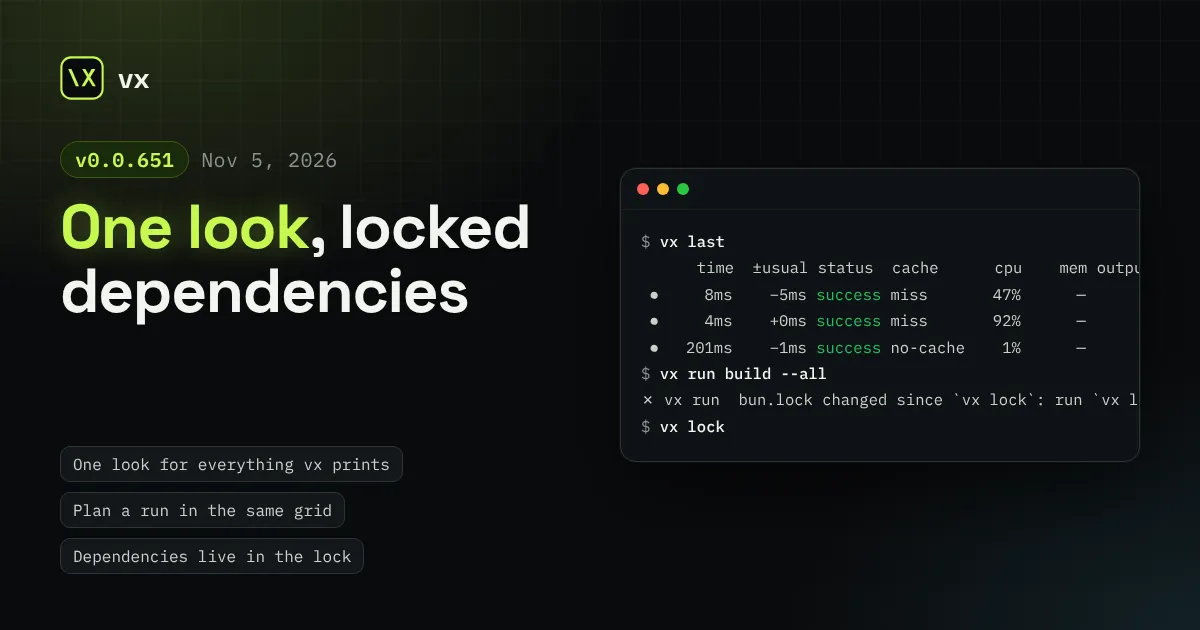
Every line vx prints comes from one kit, and a run, vx last and --dry share one task grid. vx lock records each project's dependencies, and runs key from that record.
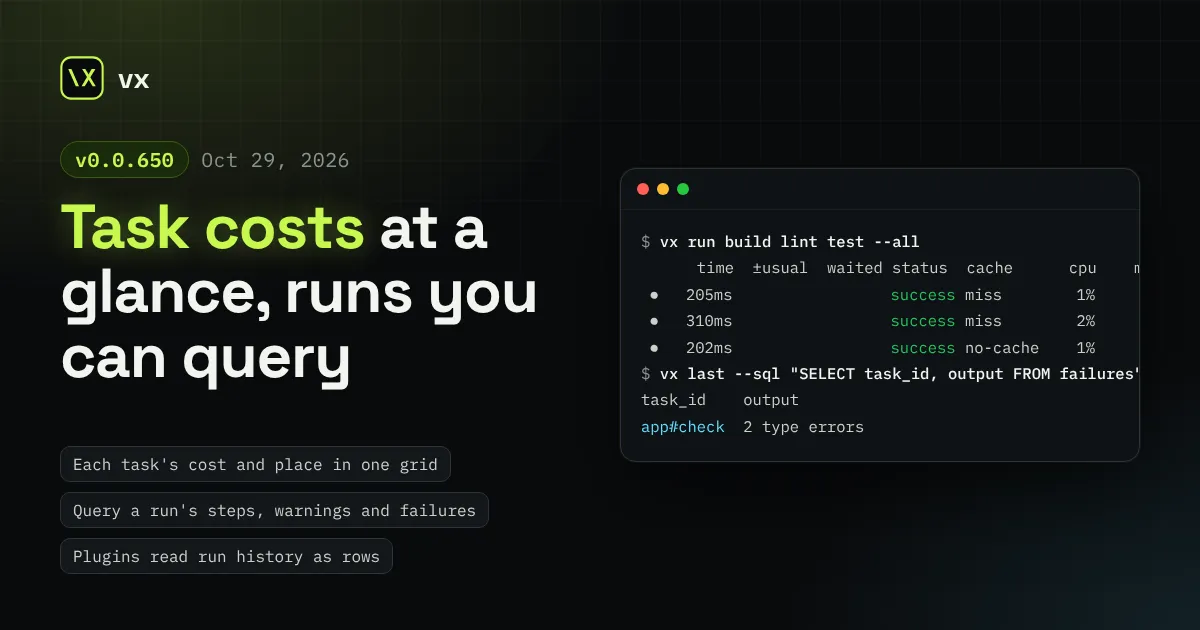
Both task lists share one grid with each task's time, wait, cpu, memory, outputs and worker. A run's steps, warnings and failures are tables vx last --sql reads.