
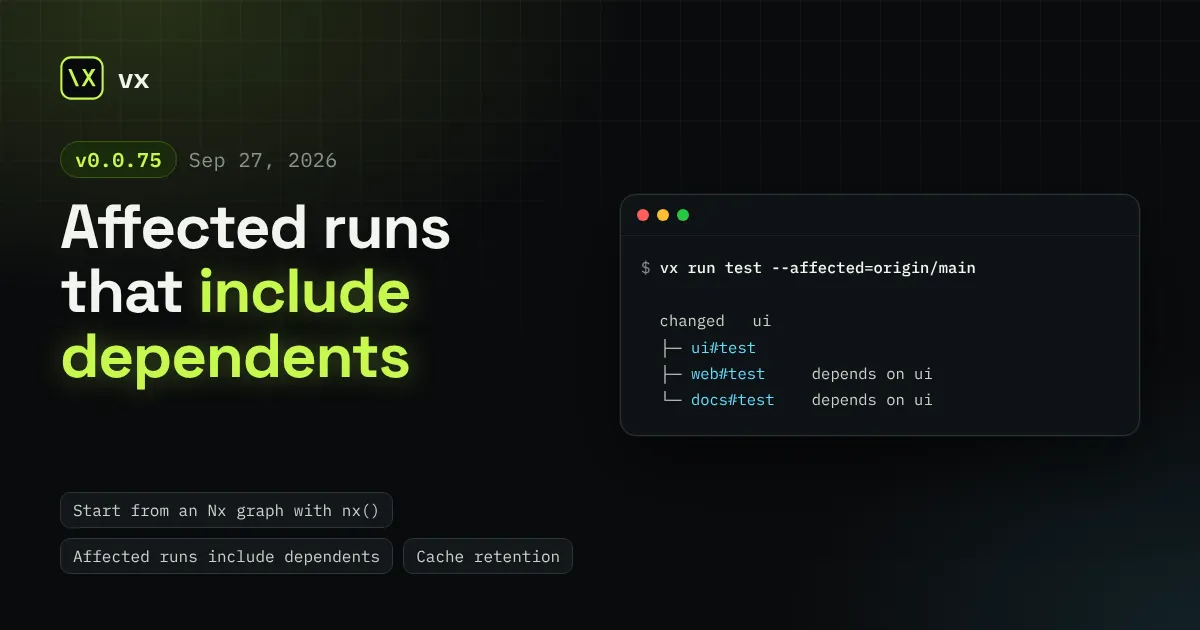
Affected runs that include dependents
nx() maps an Nx project graph to vx tasks with nothing written, --affected selects dependents too, and remote caches stream artifacts instead of holding them in memory.
The first 21 releases built the foundation: a TypeScript task graph with a content-addressed cache, a sandbox that proves what a task reads, and plugins for remote caches, telemetry and adoption.
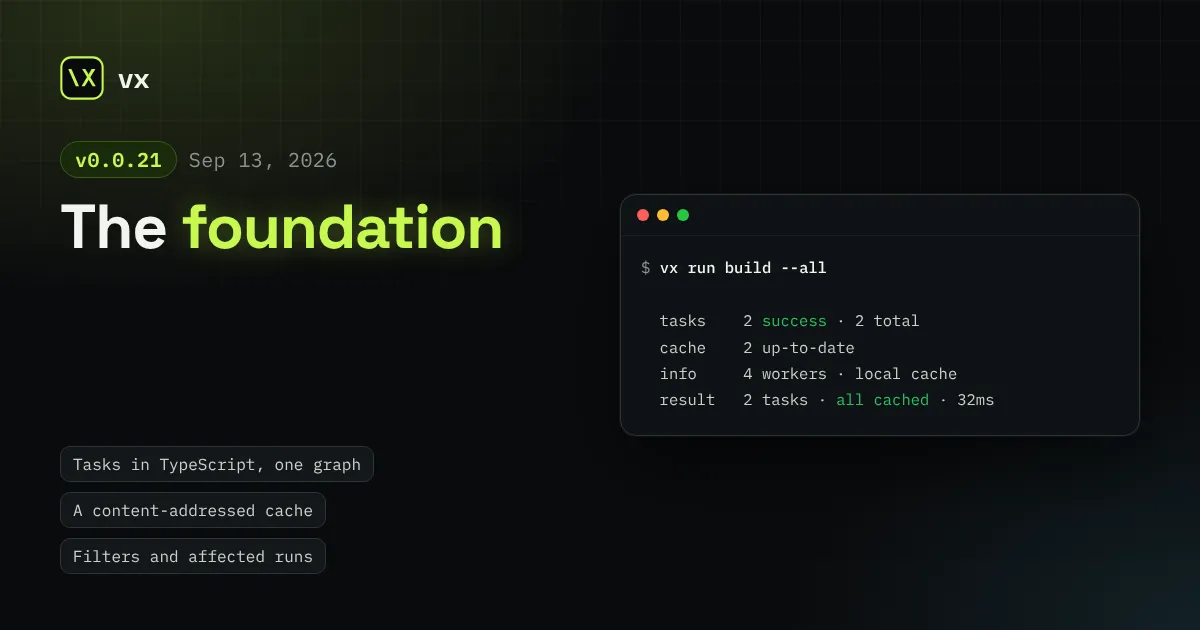
vx 0.0.1 shipped on 2026-05-13 and 0.0.21 on 2026-09-13. Those 21 releases built the foundation every later one stands on: a task graph from TypeScript configs, a cache keyed on content, and seams for plugins. This post covers what a new user meets, as it shipped then and as it still works today.
In this release
Each package declares its tasks in a vx.config.ts. A task is one shell
command, and dependsOn orders it: '^build' means build in every
package this one depends on. vx discovers the projects, evaluates every
config, and builds one graph for the whole workspace. A config is a
program, so shared settings are an import, not a special field.
import { defineProject } from '@vzn/vx/config'
export default defineProject({  tasks: {    build: {      dependsOn: ['^build'],      exec: { command: 'tsc -b' },      cache: { inputs: { files: ['src/**'] }, outputs: { files: ['dist/**'] } },    },  },})
Commit 4e7e62e. Docs: Tasks and dependencies. Deep dive: Config in TypeScript.
flowchart LR
  C["vx.config.ts"] --> G["task graph"] --> K["cache keys"] --> H{"hit?"}
  H -->|yes| R["restore outputs"]
  H -->|no| X["run, then save"]
Caching is opt-in, and a cached task lists its input files. vx never
guesses them. The key folds those files, the task’s resolved config,
the package’s package.json, the lockfile and the keys of the tasks it
depends on. Tracked, clean files are keyed by the blob ids already in
git’s index, so a warm run reads almost nothing. Entries live in a local
SQLite index with compressed archives, and a hit restores the outputs
and replays the logs.
$ vx run build --all
─ vx 0.0.0 ───────────────────────────────────────────────────  projects  ▰▰▰▰▰▰▰▰▰▰▰▰▰▰▰▰▰▰▰▰▰▰▰▰▰▰▰▰▰▰▰▰▰▰▰▰▰▰▰▰▰▰▰▰▰▰▰▰▰▰            2 in run · 2 total  tasks     ▰▰▰▰▰▰▰▰▰▰▰▰▰▰▰▰▰▰▰▰▰▰▰▰▰▰▰▰▰▰▰▰▰▰▰▰▰▰▰▰▰▰▰▰▰▰▰▰▰▰            2 success · 2 total  cache     ▰▰▰▰▰▰▰▰▰▰▰▰▰▰▰▰▰▰▰▰▰▰▰▰▰▰▰▰▰▰▰▰▰▰▰▰▰▰▰▰▰▰▰▰▰▰▰▰▰▰            2 up-to-date
  info      4 workers · local cache  time      32ms  result    2 tasks · all cached · 45ms saved · 32ms
PRs #7, #86, commit 613d527. Docs: Caching. Deep dives: Explicit over magical, Keys from git, Cascade through inputs.
--filter takes pnpm-style patterns: a name, a glob, a path, a
package with its dependencies (app...) or dependents (...lib).
--affected selects what changed since a git base, origin/HEAD by
default. A change to a workspace-level file that every key folds, such
as a lockfile no plugin claims, widens it to every project. A later
release made --affected include the changed projects’ dependents too.
vx run test --affectedvx watch runs a task, then runs it again on every change. Each cycle
is a normal vx run, so the cache key decides what re-runs, and an edit
to an unrelated file costs a fully cached cycle. A task that writes into
its own project does not trigger itself: a cycle starts only when file
contents differ, not on every event.
vx watch test --allPR #67. Deep dive: Watch mode.
exec.persistent marks a server or watcher that does not exit. Its
dependents start once it prints a line matching readyWhen, not after a
sleep. When the run ends, vx stops the server, and Ctrl-C leaves nothing
running.
import { defineProject } from '@vzn/vx/config'
export default defineProject({  tasks: {    dev: {      exec: { command: 'vite', persistent: { readyWhen: 'Local:' }, timeout: 30_000 },    },    e2e: {      dependsOn: ['dev'],      exec: { command: 'playwright test' },    },  },})
PRs #62, #189. Docs: Dev tasks. Deep dives: Dev servers in the graph, Ctrl-C.
exec.sandbox runs a task where only what you granted exists. You
declare capabilities (read, write, network) and vx maps them to
bubblewrap on Linux and the system sandbox on macOS. An undeclared read
or write of the task’s own files fails the task and names the path, and
a failed task is never cached. That turns an input list from a promise
into a checked boundary.
import { defineProject } from '@vzn/vx/config'
export default defineProject({  tasks: {    build: {      exec: {        command: 'vite build',        sandbox: { allow: { read: ['.'], write: ['dist/**'] } },      },      cache: { inputs: { files: ['src/**', 'index.html'] }, outputs: { files: ['dist/**'] } },    },  },})
PRs #15, #102, #245, commit d7f6e74. Docs: Sandboxing tasks. Deep dive: The sandbox.
vx why compares a task’s last two runs and names what moved its key: a
file, an env var, a config field, an upstream task. vx last replays a
recorded run’s summary from local history. Both read only what the runs
already stored.
$ vx why lib#buildlib#build — run 01a11d16-a5b0-74af-a52d-bb0bbf33a1ed  this run   2026-10-08T19:56:25.939Z · success · executed · key 49a37e4bfb0bd487  previous   2026-10-08T19:56:18.576Z · cache-hit · up-to-date · key e291b2e50af34f01  verdict    cache key changed: file packages/lib/src/index.js
  what changed (1 component, 4 unchanged):    changed file  packages/lib/src/index.js  09b76aaa26ac6afc3f6b09805e8ede78e0637954 → 838198e50b78e865ce6cde1f69d359ffeacc3063
  what to do:    file  an edit re-runs by design; a file the task does not read belongs out of cache.inputs.files
Commits 7edfaeb, 4013941, PR #333. Docs: Why did it re-run?. Deep dive: Why did this re-run?.
vx lock writes every project’s resolved config to vx-lock.json.
vx run --frozen builds the graph from that file instead of evaluating
configs, and vx lock --check fails when the two drift. Run both in CI
and the graph a run sees is the one you reviewed.
$ vx lockvx lock: locked 2 project configs → vx-lock.json$ vx lock --checkvx lock --check: up to date (2 projects)Commit 133a55a. Docs: A frozen graph. Deep dive: vx lock.
Core runs and caches on this machine and applies no plugin by default.
Everything else is a plugin declared in vx.workspace.ts, named by its
package. By 0.0.21 these shipped: @vzn/vx-reapi (remote cache and
remote execution on any Bazel REAPI server), @vzn/vx-lockfile (each
package keyed on its own dependencies), @vzn/vx-otel (OpenTelemetry),
a GitHub Actions job summary (today @vzn/vx-ci), @vzn/vx-mcp (a
vx mcp server for coding agents) and @vzn/vx-schedule-history.
import { defineWorkspace } from '@vzn/vx/config'import { bun } from '@vzn/vx-lockfile'import { reapi } from '@vzn/vx-reapi'
export default defineWorkspace({  plugins: [bun(), reapi({ endpoint: 'grpcs://cache.internal:443' })],})
PR #259, commits 02d6b67, a485690, b5e534d. Docs: Plugins. Deep dives: A pipeline with seams, Remote execution, Lockfile-aware keys, Agents and MCP.
@vzn/vx-migrate covers adoption. Its turbo() plugin runs a Turbo
repo under vx with nothing written, reading turbo.json and the
package scripts each run. bunx @vzn/vx-migrate writes native
vx.config.ts files from turbo.json or an Nx graph, and
turboCache() and nxCache() keep an existing remote cache. In any
other repo, vx init writes starter configs from the package.json
scripts.
bunx @vzn/vx-migratePR #302, commit 1487872. Docs: Migrate. Deep dives: From Turborepo, From Nx.
@vzn/vx, and a project config lists tasks
directly, with no run: { tasks } wrapper
(#43).See Upgrading.
npm install -D @vzn/vx@latestA standalone binary updates itself with vx upgrade.
nx() maps an Nx project graph to vx tasks with nothing written, --affected selects dependents too, and remote caches stream artifacts instead of holding them in memory.
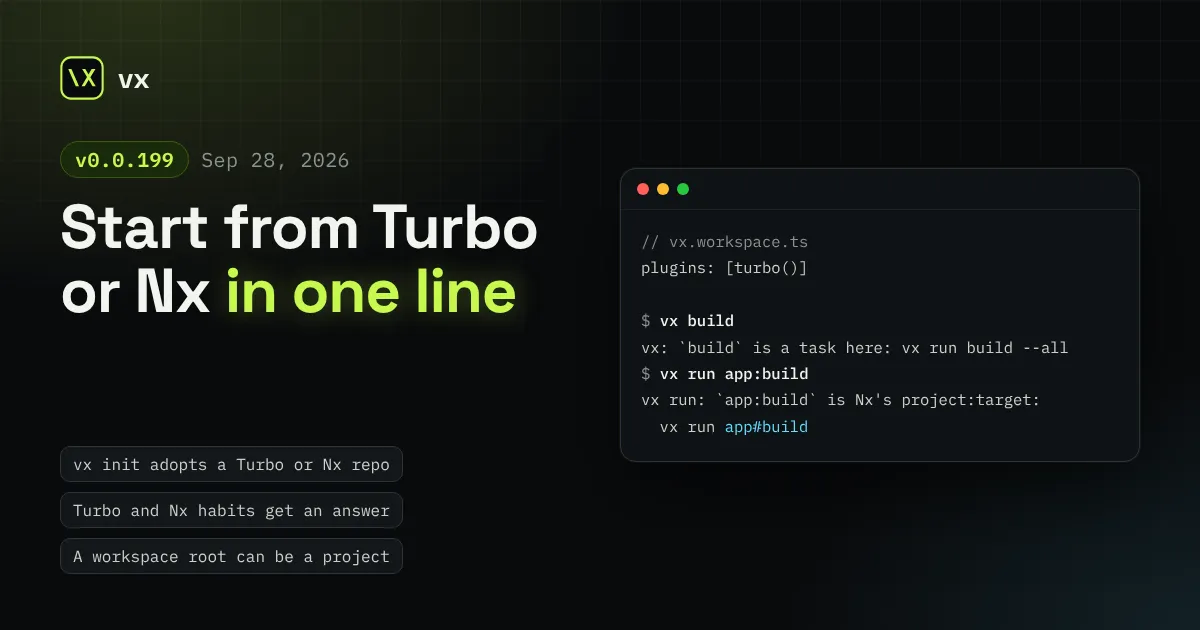
vx init now sets up a Turbo or Nx repo with one plugin line, the workspace root can hold tasks, and vx last jumps straight to the run that failed.
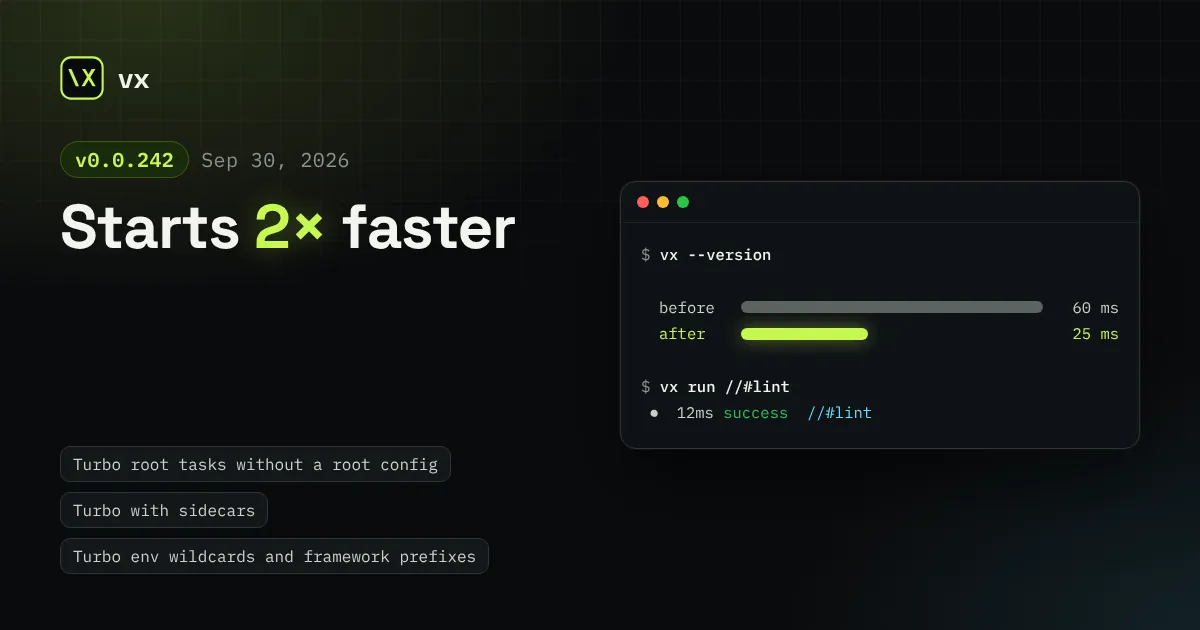
turbo() now runs root tasks, single-package repos and with sidecars as Turbo does, nx() finds every project in an integrated repo, and the CLI starts 2× faster.