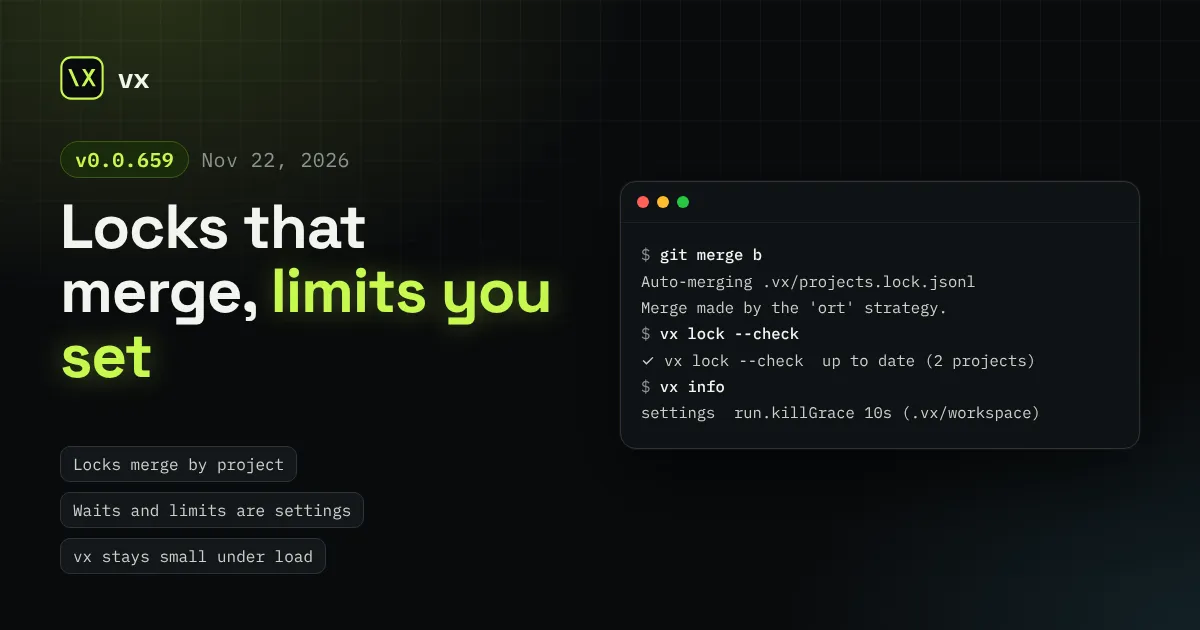
The locks are text keyed by project name, so two branches merge them by project. The waits and limits a user feels are settings, vx stays small under big outputs and slow readers, and migrated Turbo configs hold only what each task declares.
The locks are now text, a line per project, so two pull requests that
each ran vx lock merge them by project. A merge touches only what each
branch changed.
The waits and limits a user can feel are settings. vx keeps its memory
flat under huge outputs, big inputs and slow readers.
Every install rewrote one hash at the top of the dependencies lock. Two
pull requests that touched the lockfile conflicted there, even when
they changed different projects.
Both locks are now sorted text keyed by project name:
.vx/projects.lock holds each project’s final config, a
line per project, and each distinct task once on its own line.
.vx/dependencies.lock holds each project’s edges and digests,
a line per project. A run checks the digests against the lockfile.
flowchart LR
  A[branch a: edits app] --> M[git merge]
  B[branch b: edits lib] --> M
  M --> L[app line from a, lib line from b]
  L --> C[vx lock --check passes]
Here one branch changed app’s build and the other lib’s:
Terminal window
$ git merge b
Auto-merging .vx/projects.lock
Merge made by the 'ort' strategy.
$ vx lock --check
✓vx lock --check up to date (2 projects)
Only a project both sides changed conflicts; then a run refuses the
lock until vx lock rewrites it.
The locks stay LF in a clone that checks text out as CRLF.
bunx @vzn/vx-migrate put turbo.json’s global block on every task
through a shared vx-preset.ts. vx has no global inputs.
Each vx.config.ts is now self-contained. The report names the global
values, and each task gets a to-do to list what it reads:
Terminal window
$ bunx @vzn/vx-migrate
from turbo.json
tasks 4 todo
todo app#build, app#test, lib#build, lib#test:
turbo.json's global block is not carried: list the files and env this task reads in its inputs
files packages/app/vx.config.ts
packages/lib/vx.config.ts
.vx/workspace.ts
.vx/.gitignore
lock 2 project configs → .vx/projects.lock.json
turbo.json's global block (globalDependencies [".env"], globalEnv ["CI"]) is carried onto no task: list what each task reads in its own inputs and exec.env.passThrough
next vx run build --all
vx init, then bunx @vzn/vx-migrate, now declares the lockfile
plugin, so the vx lock after it passes. A lone package loses its
^build.
.vx/projects.lock.json → .vx/projects.lock.jsonl, and .vx/dependencies.lock has a new format. Run vx lock once after upgrading and commit both; until then a run says so:
Terminal window
$ vx run build --all
✗vx run no lock: run `vx lock`
cache.artifactCeiling defaults to 1 GiB, not 2 GiB. RunOptions.artifactCeiling is removed.
PreparedRun.keepRunEntry takes (name, body: Blob), not (name, bytes: Uint8Array).
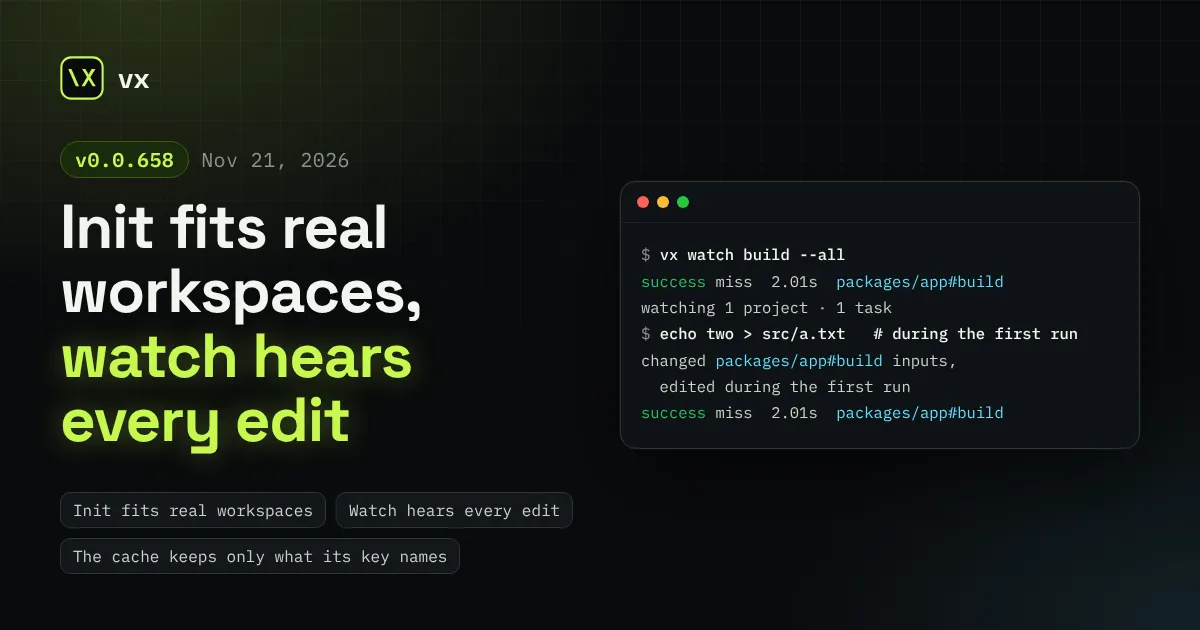
vx init writes configs that run on real Nx, pnpm and Next.js workspaces. vx watch hears every edit made during its first run, the cache keeps only bytes its key names, and distributed task execution plans with one engine.
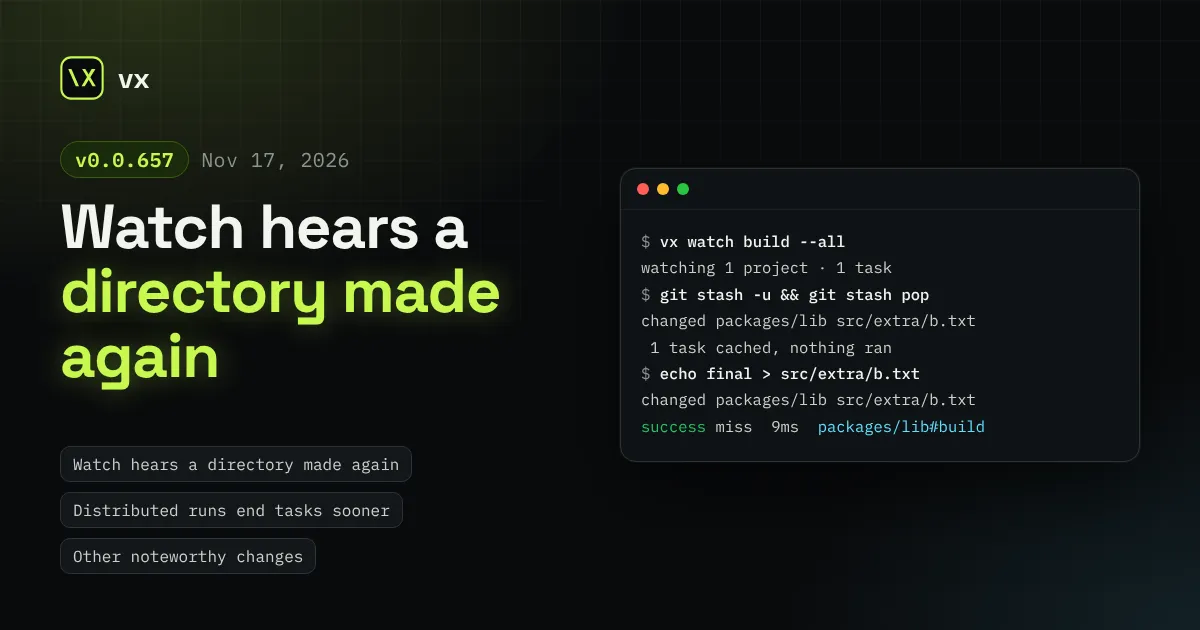
vx watch keeps hearing a directory that was removed and made again, as git stash and a branch switch do. A damaged cache file is named with its remedy, and distributed runs end tasks sooner.
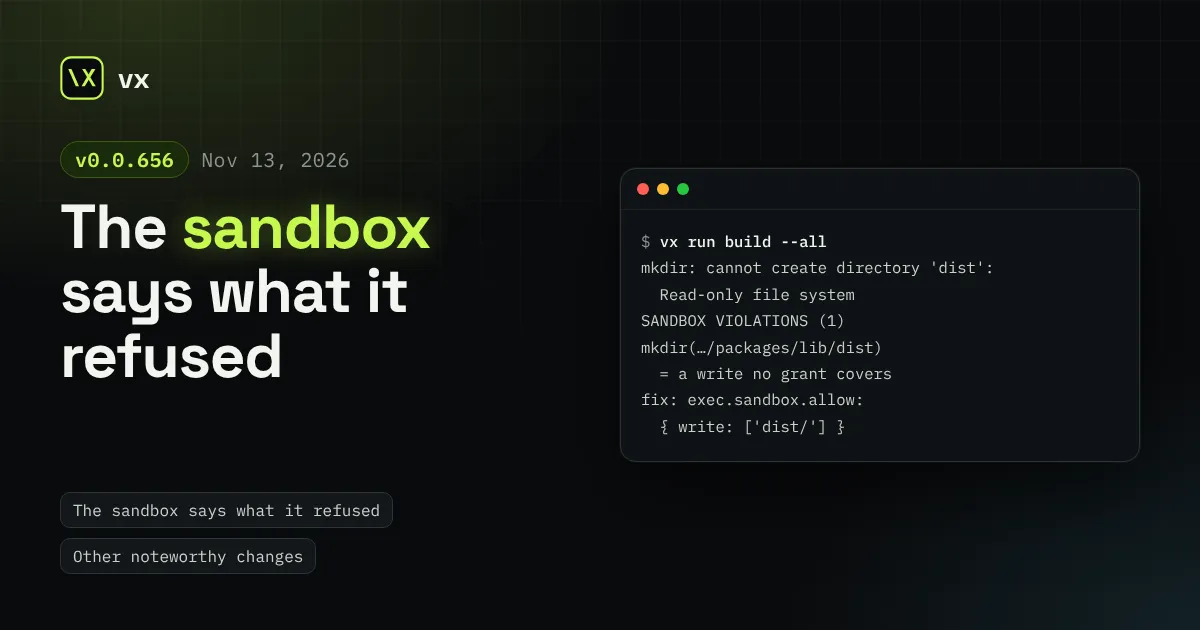
On Linux, the vx installed from npm reports a write its sandbox refused, with the grant to add, and blocks unix sockets again. A sandbox that reads none of its project offers the whole-project grant.
Turborepo, Nx and other product names are trademarks of their owners. vx is not affiliated with or endorsed by them.